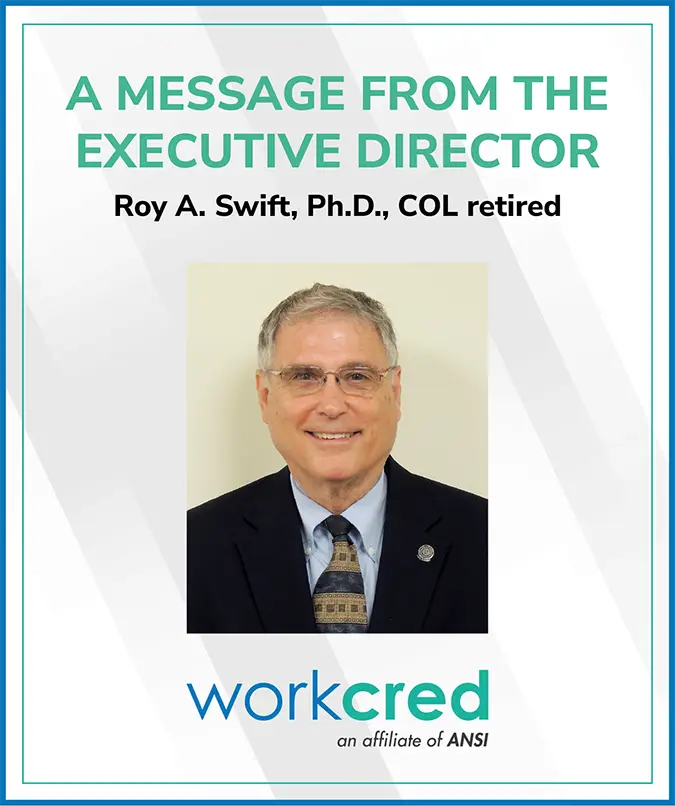
Success Takes a Village: Why Quality Credentials Need a Strong Community to Thrive
January 28, 2026
As I reflect back on the 12 transformative years that have passed since Workcred first embarked on its mission, I am grateful. The journey to build quality and trust in life-changing credentials wouldn’t have been possible without the support of my phenomenal village: colleagues across the workforce industry, our Board of Directors, and a high performing staff who have always driven our organization’s success.
As we expand on our mission—and in light of my retirement this February—I am proud to share inspiring updates that build on our foundation, and reflect how Workcred will continue to advocate for the quality and effectiveness of credentials by improving pathways that prepare workers for fruitful and rewarding careers.
Keeping Our Work in Motion
We are thrilled to announce our partnership with Dallas College under a four-year, U.S. Department of Education-funded grant to integrate AI across higher education and workforce training. This collaboration will advance the understanding and use of AI to improve student outcomes and better position the Dallas College to meet emerging technology needs. Most importantly, this initiative will prepare students for the future of work and pave the way for other colleges to embark in similar efforts.
Our partnerships with higher education continue to grow in scope and impact.
Recently, through a Greater Texas Foundation grant, we collaborated with Houston City College and Texas Southmost College to develop several comprehensive case studies, recommendations,
and a guidebook revealing how community colleges can better connect academic curricula and industry credentials with local job market skill needs.
These resources address a critical gap in workforce education, bridging the disconnect between what students learn and what employers actually need.
What’s more, they prove that alignment between education, industry, and policy is not just theoretical—it is achievable and replicable.
We are also grateful for a grant from the Powell Foundation that gave Workcred and Houston City College the opportunity to examine how state and institutional policies can better support students in career pathways that incorporate industry credentials to meet regional workforce needs. This work culminated in a case study to showcase how HCC changed existing institutional policies to align to new policies in Texas to better support learners
to achieve the skills they need to enter the workforce, and a report on recommendations for community colleges to use in improving the effectiveness of career pathways.
Building a talent pipeline with the right skills is a key priority as demand for cybersecurity professionals continues to grow. We recently partnered with the Cyber Ready Professionals Consortium (formerly the National CyberWatch Center)
to develop a competency-based accreditation model that evaluates learner skills and the effectiveness of community cybersecurity clinics. The model provides a framework to ensure these clinics deliver hands-on, real-world experiences aligned with industry needs.
This model addresses a critical national security need by establishing consistent quality standards to ensure cybersecurity clinics produce job-ready professionals.
As always, there is more to come! Keep up with our progress and news on our ever-improving website, recently simplified to better highlight Workcred’s unique expertise and approach to bring greater clarity to the quality of credentials.
Final Thoughts for a Brighter Tomorrow
Even as we celebrate our successes, our work continues. I must emphasize the need for more cooperation among organizations, and a hypervigilance towards the current environment and explosion of credentials, as their effectiveness to meet the ever-evolving needs of the
workforce and employers may not always be their main goal. While there is considerable credential innovation, rigorous evaluation of its effects is rare—and when it does occur, it places greater emphasis on wage outcomes rather than measuring other aspects of each credential’s impact and societal contribution.
Workcred was founded on a powerful idea: that skills, competencies, and credentials should be transparent, trusted, and aligned with real workforce needs. Quality is the foundation on which people build their trust in credentials, and we have worked endlessly to make an impact with that mission.
I know this work will continue in good hands after my retirement. Our associate executive director of operations, Karen Elzey, who has been with us almost from the beginning, will serve as the interim executive director. Her deep knowledge of credential quality,
education-to-workforce pathways, and employer engagement make her ideally suited to take on leadership of Workcred during this transition.
Thank you for all of your support over the years. I wish every success to everyone who will continue the hard work to ensure that credentials have quality and value for everyone.
Sincerely,

Roy A. Swift